
On proportion, material, and how furniture shapes a space.
Written by Tiffany O’Hare
In residential design, furniture is often introduced late in the process, after the architecture is defined, the materials are selected, and the space is, in many ways, already decided. It is expected to complete the room. The most considered interiors are not assembled this way, but developed with a different level of attention, where proportion, material, and placement are addressed together, and furniture becomes part of the structure rather than an addition to it.
This is the role of custom furniture in residential design. It is no longer a niche solution, but a central part of how high-end residential spaces are conceived.
Beyond Standard Furniture
Standard furniture operates within a fixed logic. It is designed to work broadly across many types of spaces, with dimensions and profiles that anticipate a range of conditions. It succeeds in versatility, but rarely in specificity. And it is precisely that specificity where design begins, particularly in high-end residential projects across leading design markets such as Los Angeles, New York, Miami, Chicago, and San Francisco.
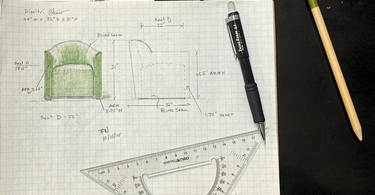
A seat height establishes a datum line across a room. A depth determines how space is occupied or left open. An arm profile can interrupt a visual field or allow it to continue. These are not stylistic decisions, but spatial ones that shape how a room is experienced.
Custom Furniture as a Design Tool
Custom furniture allows those decisions to be made with intention. Dimensions are not selected from a range, but developed in response to the room. Profiles are refined to align with the architecture, and materials are considered as part of a continuous palette rather than a layer introduced at the end. For interior designers, this level of control defines custom furniture and distinguishes it from standard solutions.
As expectations continue to rise across the design industry, particularly in cities where residential design is both competitive and highly visible, custom furniture and custom upholstery have become essential. They allow designers to create spaces that feel cohesive, intentional, and specific to the people who live in them.
When furniture is considered at this level, it does not call attention to itself. It reinforces what is already there. The space feels complete, even if the reason is not immediately visible.
Performance Over Time
There is also the question of how a piece performs over time. Comfort is constructed, not incidental. Support is specified, not assumed. Durability is not a feature, but a requirement. These decisions are embedded in the making, shaping how a piece is used and how it holds up over time.
The Designer and the Maker
For this process to work, the relationship between designer and maker becomes essential. With direct collaboration, there is less translation, fewer assumptions, and a clearer path between intent and execution, particularly when developing custom furniture for interior designers working on complex residential projects.
This is the framework behind Black Label Home, a trade-only studio developing custom upholstery and furniture in direct collaboration with interior designers and architects across the United States. Founded by Robert Wylie, the work is not based on offering variations, but on arriving at the correct solution for each project with clarity and precision.
The difference is rarely dramatic. It is found in proportion, in alignment, and in the decisions that allow a space to hold together. That is where custom furniture proves its value.
For projects where every detail matters, custom furniture is not an addition. It is part of the work.
